Every State Just Got RHTP Money. Now They Have 5 Months to Figure Out Where It Goes
On December 29, 2025, the Centers for Medicare & Medicaid Services announced that every state in the country had been awarded money from the Rural Health Transformation Program.
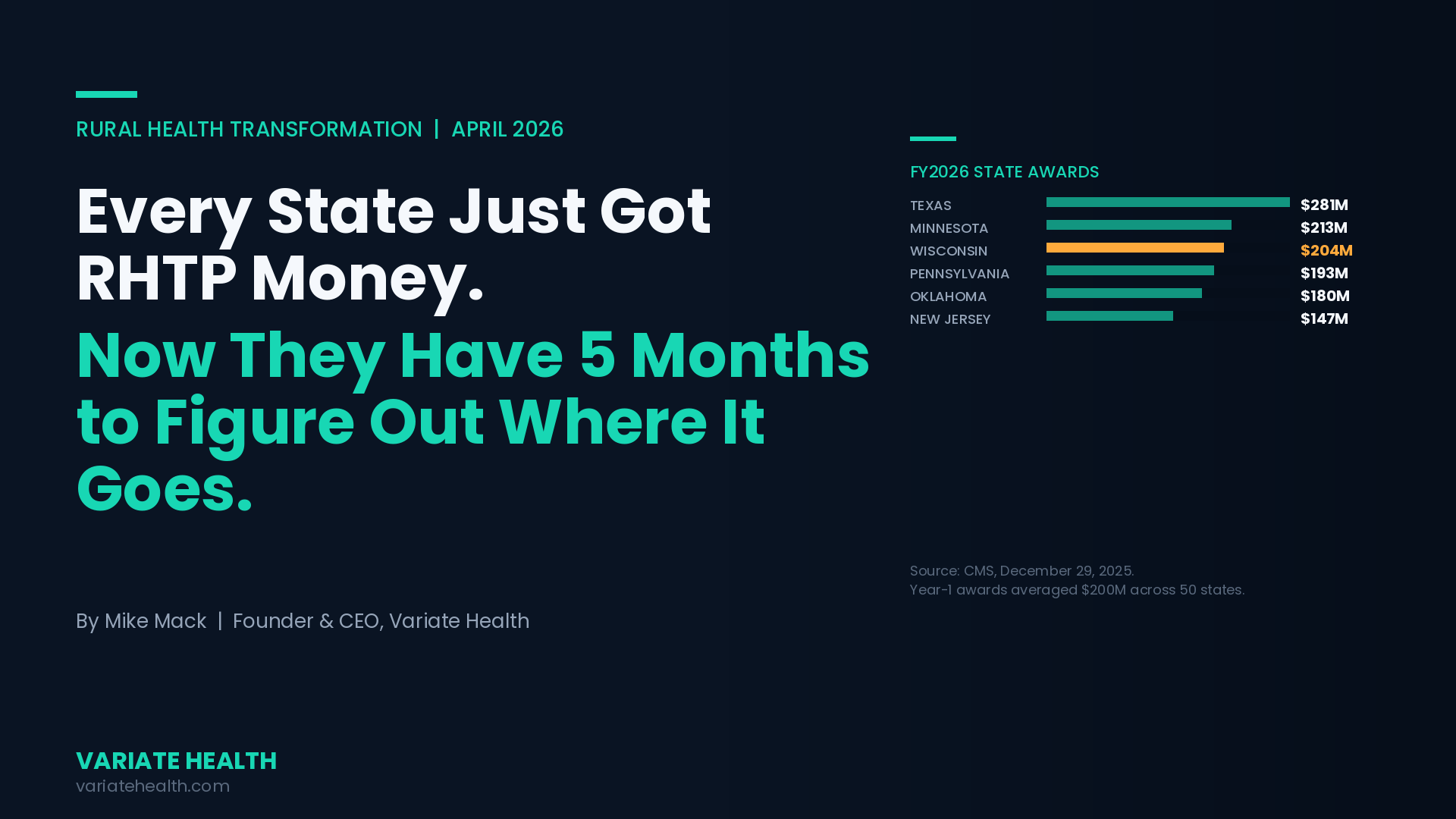
All 50 states. Texas got $281 million. New Jersey got $147 million. Wisconsin got $203.7 million. The average award was $200 million. Over five years, the program will distribute $50 billion.
That's the good news. Rural healthcare in America is getting a level of federal investment it hasn't seen in a generation.
Here's the less obvious news: Year-1 funds have to be obligated by September 30, 2026.
That gives state health departments and their rural partners roughly five months to decide which counties get what, which initiatives get funded, and which vendors get picked.
The money is real. The deadline is coming. But the hard part isn't the money.
The hard part is the targeting.
The allocation problem nobody is talking about
Imagine you run Wisconsin's new RHTP program. You have $203 million for Year 1. You have three approved initiatives: rural workforce recruitment, technology and interoperability infrastructure, and population health investments. Your state has 38 rural-designated counties. Your job is to decide how the money flows.
Where do you start?
Most states are building their allocation logic on three inputs: population density, stakeholder input from hospitals, and the CDC's Social Vulnerability Index. Each of these tools has value. None of them are good enough to decide where $203 million should go.
Population density misleads you. A rural county might be densely populated by rural standards and still be one of the healthiest in your state. A less populated county might be the exact convergence of chronic disease burden, aging population, and healthcare access gaps that would benefit most from your intervention. Density tells you how many people live somewhere. It doesn't tell you how sick they are, or what's making them sick.
Asking hospitals gives you a wishlist, not a strategy. Every hospital will tell you they need more money, more staff, more technology. They're right. But the hospital's view of "need" is bounded by what they see inside their walls. They don't see the patient who drives past their ER to a hospital in the next county because the ER wait is shorter. They don't see the population that never shows up at all.
SVI alone is too blunt. The Social Vulnerability Index was designed to help emergency managers identify communities that might struggle to recover from disasters. It's a fantastic tool for that. But SVI rolls poverty, language barriers, housing quality, and transportation access into a single score. A census tract might score critically high on SVI because of poverty and language barriers — not because of any specific disease burden. If your RHTP Initiative 3 is targeting chronic disease prevention, SVI will send you to the wrong neighborhoods roughly a third of the time.
What you actually need is the ability to ask a very specific question. Something like:
"Show me the census tracts in my state where diabetes prevalence is above the 80th percentile AND the population over 65 is above the 75th percentile AND there is no hospital within 15 miles AND health insurance coverage is below the state average."
That's four variables, pulled from three different federal datasets, with a negative weight on hospital proximity. Population density can't answer that. SVI can't answer that. Your state Medicaid team could answer it — in about six weeks of custom GIS work per question.
That's the pattern. Every state with RHTP funds has roughly 50-100 of these questions to answer before September 30. No state has the internal capacity to answer them all.
What's actually funded across the 50 states
Looking at the published state RHTP abstracts — tracked by Sellers Dorsey and others — most states included overlapping themes:
- Rural workforce recruitment and retention. Training programs, loan repayment, rural residency slots.
- Technology and interoperability. Telehealth, EHR integration, regional IT hubs, broadband.
- Population health infrastructure. Chronic disease management, maternal health, behavioral health, food-as-medicine programs.
- Facility modernization. Upgrading aging rural hospital infrastructure.
- Care coordination. Regional collaboratives linking hospitals, FQHCs, community health centers.
Pennsylvania proposed eight Regional Rural Care Collaboratives. California wants regional care collaboratives linking rural hospitals and FQHCs. Colorado is expanding chronic disease and food-as-medicine networks. Minnesota is incorporating EMS into its plan.
These are good initiatives. But notice what they have in common: every one of them requires the state to decide where the investment goes within the state. And every one of them is harder to target well than to spend quickly.
Spending quickly is easy. You pick a few big rural hospitals, cut them checks, and tell CMS the money was "obligated." That satisfies the deadline. It doesn't transform anything.
Targeting well is what moves the needle on the five CMS goals: Make Rural America Healthy Again, Sustainable Access, Workforce Development, Innovative Care, and Technology Innovation.
What "good targeting" actually looks like
If your state is serious about targeting well, the allocation model should satisfy five tests:
- Census-tract resolution, not county. Rural counties are large and heterogeneous. The disease burden in one corner of a county often has nothing to do with the burden in another corner. If your model can't distinguish the two, your investments will hit the wrong places.
- Multi-variable composition, not single-index. A real health burden picture requires layering disease prevalence (CDC PLACES), social vulnerability (SVI), environmental risk (EJI, Health and Heat Index), healthcare access (CMS Hospital Compare, HRSA shortage areas), and demographics. A single-index view is always an abstraction that smooths out what matters most.
- Negative weights allowed. "Where is diabetes high AND hospital access low" requires the model to weight hospital proximity negatively. Most off-the-shelf geographic tools don't do this. They'll happily show you where both variables are high, which is the opposite of what you need.
- Population counts, not percentiles. "This census tract ranks in the 90th percentile" is useful. "This census tract has an estimated 4,200 people aged 65+ matching your criteria" is actionable. The second answer drives funding decisions; the first drives debate.
- Natural-language iteration. Your RHTP team will need to ask 50-100 of these questions between now and September 30. If each question requires a new GIS work order, you'll answer five of them. If your team can iterate verbally in a meeting, you'll answer all fifty.
These are the requirements for any geographic targeting capability a state relies on. They're not specific to any vendor or tool.
What state RHTP teams should be asking right now
If you're on a state RHTP implementation team, here's the question to bring to your next meeting:
"Before we approve the FY2026 subgrant RFPs, do we have a shared, defensible, auditable geographic model of where our rural health burden actually lives — down to the census tract, across multiple disease categories, layered with access gaps and social vulnerability?"
If the answer is yes, great. You're ahead of almost every other state.
If the answer is "we're using SVI," or "we're using a county-level overlay," or "we're working with an advisory committee on this," those are partial answers. SVI is a starting point, not a destination. Counties are too coarse. Advisory committees are political instruments — they're necessary, but they're not analytic instruments.
CMS was explicit about this when they announced the awards. 50% of future funding allocations will be based on each state's performance against its plan targets. Which means targeting well isn't just about Year 1 impact. It's about whether the state gets its full Year 2, Year 3, Year 4, and Year 5 allocations — or whether CMS reduces them.
That's a 5-year compounding performance tournament. The states that target well in Year 1 set themselves up for more money in Years 2-5. The states that spread the money thin based on politics or legacy relationships will see their awards shrink.
If you're working on RHTP targeting in your state and want to compare notes, I'm happy to talk. Contact me at mike@variatehealth.com.
Mike Mack is the founder and CEO of Variate Health, an AI-powered geospatial intelligence platform for healthcare. He previously built geospatial analytics platforms for Apple, Walgreens, and Rite Aid, with over 1M analytic territories and 6 predictive platforms across Fortune 500 retail. He holds patents in geospatial analytics and is based in San Francisco, CA and Madison, WI.